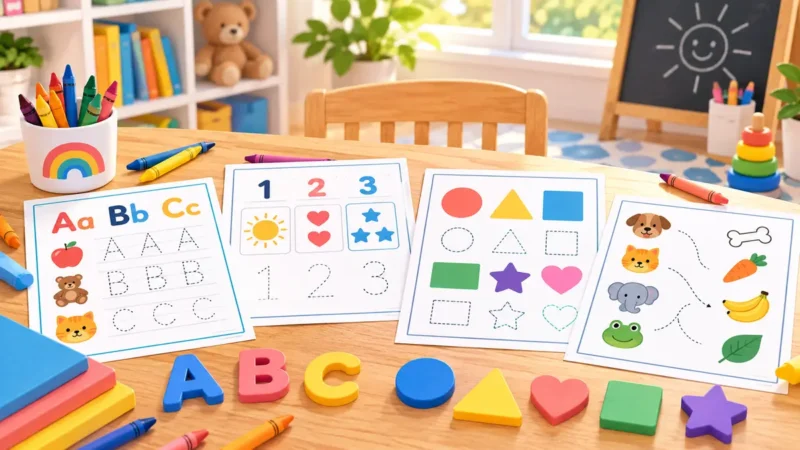
Shapes and colors are everywhere, which makes them ideal for preschool learning. Printable activities can introduce clear examples, while everyday objects help children apply the same ideas beyond the page.
Core shapes to introduce first
Begin with a circle, square, triangle and rectangle. Once these are familiar, add stars, hearts, ovals and other shapes. Use consistent examples at first, then show that the same shape can appear in different sizes, colors and positions.
Simple color-learning activities
- Sort crayons, blocks or bottle caps by color.
- Choose a “color of the day” and find matching objects.
- Match colored shapes on a printable page.
- Mix safe paints to explore how new colors are made.
- Create a collage using one or two selected colors.
Use a focused printable book
Practice recognizing, tracing, sorting and matching common shapes and colors.
Five playful shape games
- Shape hunt: find circles, rectangles and squares around the room.
- Build a picture: combine paper shapes to make a house, robot or animal.
- Sort and explain: ask why two objects belong in the same group.
- Trace real objects: trace around a cup, block or safe container.
- Match silhouettes: pair an object with its outline.
Ask open questions such as “How do you know this is a triangle?” or “Can you find another shape with four sides?” This encourages observation and language alongside visual recognition.
When to add logic and matching
After a child can identify several shapes and colors, use simple patterns, picture pairs, same-and-different tasks and category matching. The Preschool Logic & Matching Activity Book provides a natural next step.
One bundle, several early-learning skills
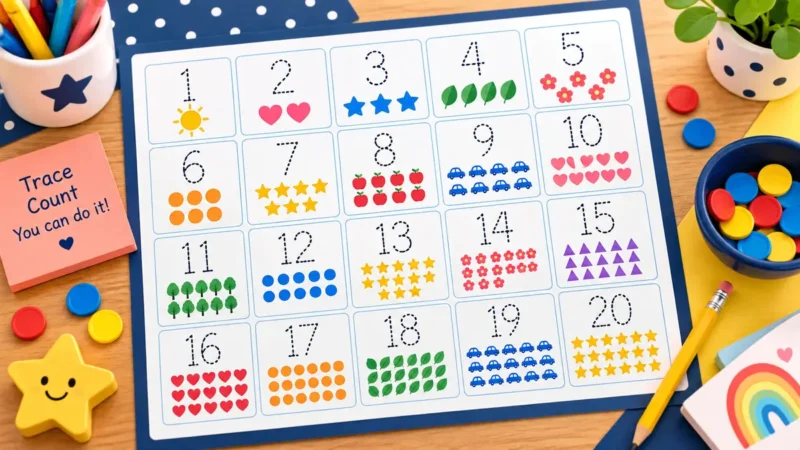
Use coordinated alphabet, number, shape, color and logic activities without searching for separate downloads.
Frequently asked questions
Which shapes should preschoolers know?
Circles, squares, triangles and rectangles are practical starting points, followed gradually by additional shapes.
How can I teach colors without worksheets?
Sorting laundry, choosing crayons and identifying objects during walks all provide natural color practice.
Should every activity have a correct answer?
No. Open-ended art and building activities let children experiment, while matching pages provide focused practice.