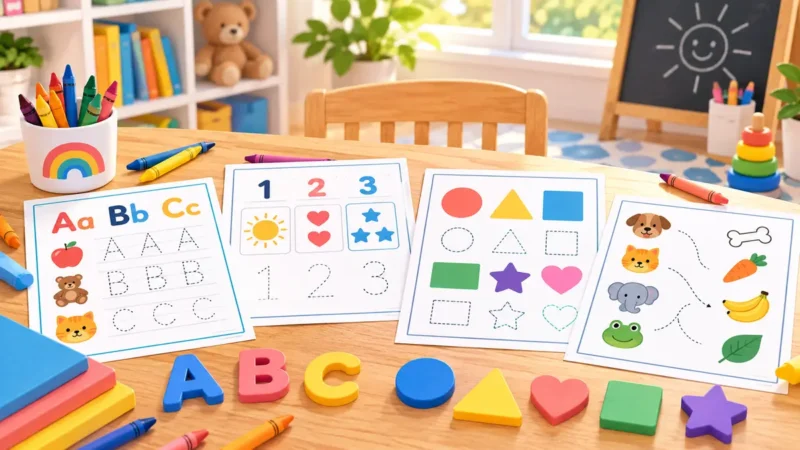
Alphabet tracing worksheets can help preschoolers become familiar with letter shapes while practicing controlled pencil movements. The most effective sessions are short, relaxed and paired with speaking, pictures and playful letter discovery.
What children practice while tracing letters
Tracing is not only about handwriting. It asks a child to notice where a letter begins, follow a path, control pressure and recognize the same symbol again. Uppercase letters are often easier to identify first because many use clear straight lines, but children can gradually practice both uppercase and lowercase forms.
How to introduce a tracing page
- Say the letter name and, when appropriate, its common sound.
- Point to the starting position and trace the large model with a finger.
- Let the child finger-trace before using a pencil or crayon.
- Complete only a few repetitions at first.
- Find the letter in a book, name card or familiar label.
Try it free
Download a six-page alphabet sampler and see whether the format suits your learner.
Make A–Z practice more playful
Pair each page with a simple object or action: A for apple, B for bear, C for clap. Build letters with craft sticks, draw them in a tray of rice, or circle the target letter on a printed page. These variations keep practice meaningful and reduce pressure.
Common tracing mistakes to avoid
- Expecting perfect letter formation too early.
- Using small or crowded worksheets.
- Correcting every mark instead of praising careful effort.
- Continuing after the child becomes tired or frustrated.
- Using tracing as the only alphabet activity.
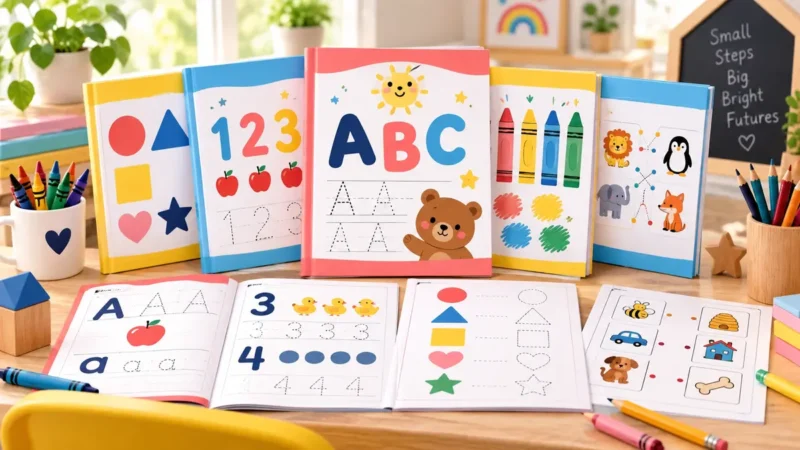
A useful worksheet should have large models, clear paths and enough white space. The Preschool Alphabet Tracing Workbook provides a dedicated A–Z sequence for ages 3–5.
Build a complete preschool routine
Combine alphabet practice with numbers, shapes, colors and matching activities.
Frequently asked questions
Should preschoolers use pencils or crayons?
Either can work. Short crayons can encourage a comfortable grasp, while pencils are useful when the child is ready for finer control.
Do children need to learn letters in alphabetical order?
Not always. Familiar letters, especially those in a child’s name, can be a motivating starting point.
How often should we practice?
A few minutes several times a week is often more comfortable than one long session.